The Art of Designing
Frameworks and Applications
Using Proven Techniques to
Overcome Creative
Contradictions
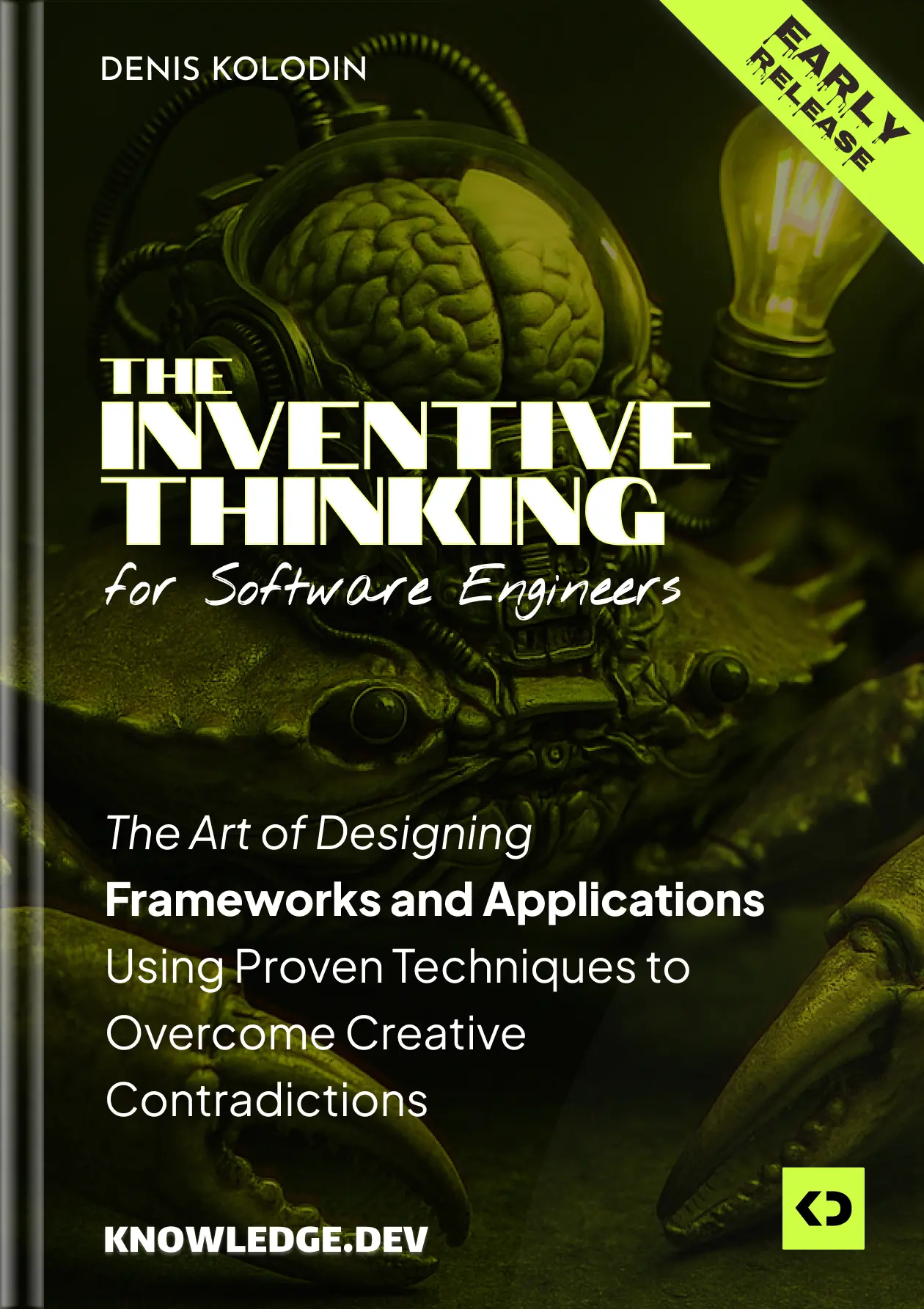
First chapters available March 30, 2026
The Inventive Thinking for Software Engineers teaches systematic approaches to innovation and problem-solving in software development. This book adapts proven engineering methodologies to help programmers resolve contradictions, eliminate technical debt, and design elegant solutions that scale.
Instead of trial-and-error or random brainstorming, you'll learn structured techniques for identifying the core conflicts in your systems, applying universal principles to resolve them, and predicting how your architecture should evolve. These methods have been successfully used in mechanical, electrical, and chemical engineering for decades—now adapted for software.
The best solutions don't come from adding more complexity—they emerge when you understand and eliminate the contradictions at the heart of your problem.
Designing systems that need to evolve gracefully over years
Facing complex tradeoffs and contradictory requirements daily
Looking for systematic ways to guide architectural decisions
Tired of reinventing solutions that already exist in other domains
Not random brainstorming, but structured problem-solving
Proven patterns that work across all engineering domains
Tools for when "both" isn't possible and compromise isn't acceptable
Predict how systems must change before hitting the wall
Real software challenges with step-by-step solutions
Objective laws of system evolution, contradictions, ideality, and psychological inertia
Segmentation • Extraction • Local Quality • Asymmetry • Merging • Universality • Nesting • Load Balancing • Prior Counter-Action • Prior Action
Beforehand Cushioning • Load Leveling • The Other Way Around • Smoothing • Dynamics • Partial or Excessive Action • Another Dimension • Polling • Periodic Action • Continuity of Useful Action
Skipping • Turn Harm into Benefit • Feedback • Intermediary • Self-Service • Copying • Cheap Short-Living • Technology Substitution • Stream Processing • Abstraction Layers
Sparse Structures • State Visualization • Homogeneity • Discarding and Recovering • Parameter Changes • Phase Transitions • Auto-Scaling • Accelerators • Sandboxing • Composite Materials
Performance vs. memory, reliability vs. speed, security vs. usability
When a component must have opposite properties: separation in time, space, conditions
Systematic lookup table: improving parameter vs. worsening parameter → suggested principles
From initial problem to ideal final result to concrete solution
Functional analysis, minimal system, zone of conflict
Using information fund: principles, standards, effects
Prerequisites for system viability
How systems evolve toward maximum efficiency
From rigid to flexible, from macro to nano
Maximum useful function with zero cost and harm
Removing components and redistributing their functions
Using what's already available: substances, fields, time, space
Past-present-future × subsystem-system-supersystem
Module → application → infrastructure, yesterday → today → tomorrow
System improvement, detection and measurement, resource usage, evolution
How GoF patterns map to inventive thinking standards
Birth, growth, maturity, decline—when to pivot
Predicting next-generation architectures and tools
Solving tomorrow's problems today
Monolith vs. microservices, SQL vs. NoSQL, async vs. sync
Speed-memory-complexity trade-offs using contradiction resolution
Applying ideality, trimming, and resource principles to legacy systems
Systematic approaches to finding and eliminating bugs
Generating innovative solutions instead of incremental improvements
Algorithm and framework choices through principle-based analysis
Building a systematic innovation practice in your team
Innovation isn't magic. It's a learnable skill based on understanding patterns, contradictions, and evolution laws that govern all engineered systems.
This book equips you with systematic thinking tools to tackle complex engineering challenges, make better architectural decisions, and predict how your systems should evolve—without relying on trial and error or waiting for inspiration to strike.
The book is in development. Get notified when the first chapters are released
Get Notified →


